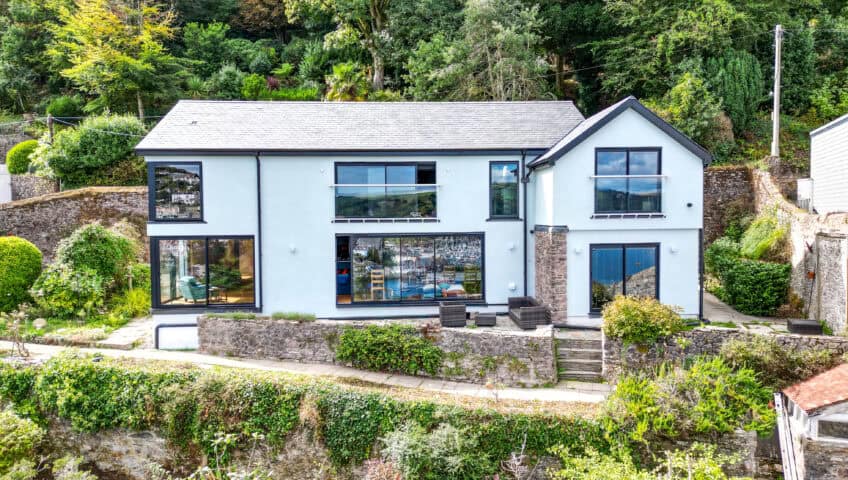
As autumn arrives, buildings across the UK face a familiar combination of heavier rainfall, stronger winds, falling temperatures and longer periods of damp weather.
For an external façade, this can be one of the year's most demanding times. Render systems need to do far more than provide an attractive finish; they form part of the building envelope and must be correctly designed, specified and installed to provide long-term protection against the elements.
At SAS Render Systems, weather resistance is a key consideration across our render, external wall insulation, and rendered rainscreen systems.
Why Autumn Weather Can Be Tough on Façades
British weather rarely exposes a building to just one condition at a time.
Periods of persistent rain can coincide with strong winds, creating wind-driven rain that places greater pressure on exposed elevations. At the same time, colder temperatures mean that moisture can take longer to evaporate and building materials may experience repeated wetting and drying cycles.
As temperatures continue to fall towards winter, freeze-thaw conditions can place additional stress on areas where moisture has been allowed to penetrate.
The design of the complete façade is therefore important. Effective weather protection depends not only on the render finish, but also on correct detailing around openings, penetrations, roof abutments, movement joints and other interfaces.
Silicone Render and Weather Resistance
Silicone thin-coat renders have become a popular choice for modern façades because they combine an attractive finished appearance with excellent resistance to the conditions encountered on external walls.
ProRend Colourtex Silicone render is designed to provide a durable, weather-resistant decorative finish while remaining vapour permeable.
Its water-repellent properties help limit the amount of rainwater absorbed by the finished surface, while vapour permeability allows water vapour within the wall construction to escape.
This balance is particularly valuable during wetter periods, when façades may be exposed to prolonged rainfall and damp conditions.
A lower level of water absorption can also help keep façades looking cleaner by reducing the conditions that encourage dirt and biological growth to become established on the surface.
Weather Protection Goes Beyond the Render
Even a high-performance render cannot compensate for poor façade detailing.
Some of the most vulnerable areas of a rendered elevation are the interfaces with other building elements. Window and door reveals, parapets, roof abutments, service penetrations, movement joints and terminations all require careful consideration.
Correctly positioned beads, appropriate sealants, effective drips and properly formed termination details all contribute to managing rainwater and preventing moisture from getting behind the façade system.
Movement must also be accommodated. Changes in temperature and moisture content can cause building materials to expand, contract or move independently of one another. Appropriate movement joints help prevent these stresses from being transferred into the rendered finish.
Good weather resistance therefore starts long before the final coat of render is applied.
 A Different Approach: The ProWall Rendered Rainscreen System
 A Different Approach: The ProWall Rendered Rainscreen System
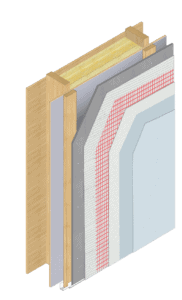
For projects requiring a drained and ventilated façade construction, the SAS ProWall system takes a different approach to weather management.
Rather than relying solely on the outer rendered surface as the primary line of defence, ProWall incorporates a ventilated and drained cavity behind the rendered carrier board.
This provides an additional level of moisture management within the façade construction.
Any incidental moisture reaching the cavity can be managed and drained, while ventilation helps promote drying behind the external façade.
This approach can be particularly valuable on framed buildings and exposed projects where movement, moisture management and long-term façade performance need to be considered together.
ProWall provides the appearance of a traditional rendered façade while incorporating the principles of a modern ventilated rainscreen system.
 External Wall Insulation Through the Colder Months
 External Wall Insulation Through the Colder Months
Weather performance is not only about keeping rainfall away from the building.
As temperatures begin to fall, thermal performance becomes increasingly important.
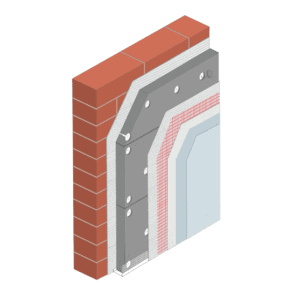
A correctly designed external wall insulation (EWI) system wraps insulation around the outside of the building, helping to reduce heat loss through the external walls and limiting thermal bridging.
The insulation is then protected by a reinforced render system and decorative finish, providing both thermal improvement and external weather protection as part of a coordinated façade build-up.
For refurbishment projects in particular, EWI can provide an opportunity to improve the appearance, thermal efficiency and weather resistance of an existing building simultaneously.
Installation Matters
The performance of any render or façade system ultimately depends on correct installation.
Autumn and winter also introduce additional challenges during application. Temperature, rainfall, wind, humidity and drying conditions all need to be considered before applying cementitious or thin-coat render products.
Applying materials during unsuitable weather can affect curing, adhesion, appearance and ultimately the long-term performance of the finished façade.
Temporary protection may therefore be required when work continues through the colder and wetter months.
Following the system specification and product application requirements is essential rather than treating weather conditions as an afterthought.
Preparing Buildings for the Wetter Months
The beginning of autum n is also a useful time to inspect existing rendered elevations.
Small defects that appear relatively insignificant during summer can allow moisture to enter once prolonged rainfall begins.
Particular attention should be paid to:
- Cracks or damaged areas of render
- Failed or deteriorated sealant around windows and doors
- Open joints around service penetrations
- Damaged beads or exposed render edges
- Parapets, copings and roof interfaces
- Areas where water is repeatedly running down or collecting against the façade
Identifying and repairing localised defects early can help prevent relatively straightforward maintenance issues developing into more significant problems.
Designed for Long-Term Façade Performance
A successful rendered façade is about much more than colour and texture.
The substrate, insulation, reinforcement, movement provision, drainage, ventilation, detailing and final finish all contribute to how the building performs when exposed to the British climate.
Whether the requirement is a traditional render finish, an external wall insulation system or a ventilated rendered rainscreen, selecting a coordinated system and getting the details right is fundamental to long-term performance.
SAS Render Systems provides technical support for architects, contractors and applicators throughout the specification and installation process, helping ensure façade systems are appropriate for both the building construction and its exposure conditions.
Planning a render, EWI or rendered rainscreen project?
Contact the SAS technical team for assistance with system selection, specifications, U-value calculations and project-specific detailing.