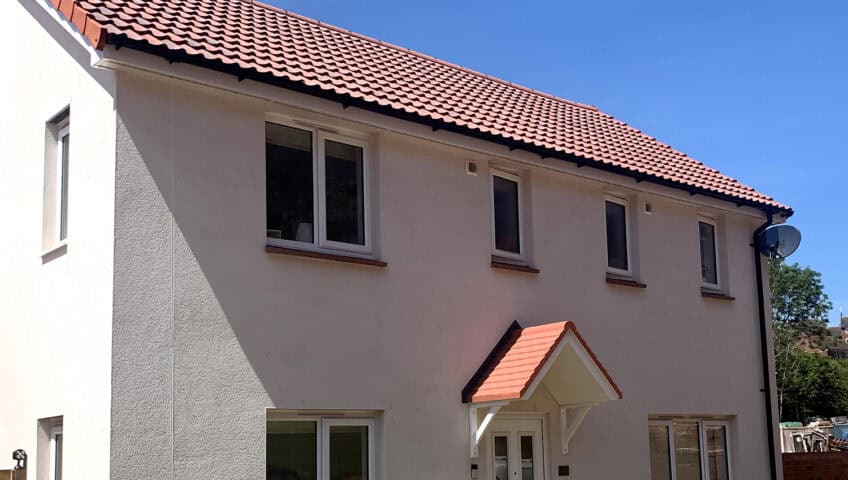
What is Monocouche Render?
Monocouche render is a through-coloured, cement-based external render system designed to provide a durable, decorative and low-maintenance finish to masonry buildings.
Supplied as a factory-batched dry powder, it only requires the addition of clean water before application. Unlike traditional sand and cement render, the colour pigment is integrated throughout the full depth of the material. This means the finish does not require painting and maintains a consistent appearance over time.
It is widely specified across the UK for:
- New build housing developments
- Residential extensions and renovations
- Low-rise commercial buildings
- Masonry blockwork façades
What Does Monocouche Mean?
The word monocouche is French for “one coat.” In modern construction, it refers to a single-layer coloured render system applied in two passes to achieve a monolithic, bonded finish.
This distinguishes monocouche from traditional multi-layer sand and cement systems that require painting after curing.
What is Monocouche Render Made Of?
Monocouche render is formulated using:
- White Portland cement (to enable pigmentation)
- Graded aggregates
- Integrated colour pigments
- Performance-enhancing additives (such as silicone or mica, depending on formulation)
The use of white cement allows manufacturers to produce a wide range of consistent stock colours.
SAS Europe’s GoRend HBS render is breathable, high-strength and available in white or ivory as standard, or a choice of 12 colours for larger orders, suitable for modern residential and commercial projects.
How is Monocouche Render Applied?
Application Process:
Substrate preparation
Ensure blockwork is dry, stable and suitable. Control high or low suction using an appropriate basecoat or primer where required.First pass (base layer)
Applied at approximately 8mm thickness. Mesh reinforcement may be incorporated where required.Second pass (monolithic bond)
Applied while the first pass is still curing to achieve a total thickness of approximately 15mm.Scraping stage
After curing (typically 5–36 hours depending on weather conditions), the render is scraped back using an I-bar and nail float to achieve the final textured finish.
Correct thickness prevents “grinning” of block joints and ensures long-term durability.
What Surfaces Can Monocouche Render Be Applied To?
It is best suited to masonry substrates including:
- 7N concrete blockwork (ideal substrate)
- Dense concrete
- Brickwork (with suitable basecoat preparation)
High-suction substrates such as aerated blocks require pre-treatment to control water absorption.
Low-suction substrates require a suitable preparatory basecoat to ensure an adequate key.
Application temperature should remain above 5°C during curing.
Key Benefits of Monocouche Render
It offers several advantages over traditional sand and cement:
- Through-coloured finish – no repainting required
- Durable and impact-resistant
- Breathable and weather-resistant
- Cost-effective for large masonry façades
- Reduced long-term maintenance
Because colour runs through the full depth, minor surface abrasions do not expose a contrasting base colour.
Monocouche Render vs Thin Coat Render
While monocouche render is primarily used on masonry blockwork, thin coat render systems are typically applied over:
Main Differences:
Feature Monocouche Render Thin Coat Render Thickness Approx. 15mm Approx. 1.5mm Supplied As Dry powder Ready-mixed tub Substrate Masonry blockwork Insulated systems Finish Scraped texture Float finish System Type Standalone masonry render System-based façade finish If you are rendering traditional blockwork, monocouche is often the preferred specification. Thin coat render is more commonly used within complete insulated façade systems.
Is Monocouche Render Suitable for Your Project?
Monocouche (one coat) render is ideal where:
- A robust, coloured finish is required
- Blockwork is the primary substrate
- Minimal future maintenance is preferred
- A cost-effective large-area solution is needed
For insulated systems, timber frame or steel frame façades, a thin coat system may be more appropriate.
Technical Support & Specification Guidance
SAS Europe provides both monocouche and thin coat render systems, supported by full technical guidance from specification through to installation.
If you are unsure which render is appropriate for your project, our technical team can advise on:
- Substrate suitability
- Exposure conditions
- Detailing and movement joints
- Installation best practice
Call 01647 24620 or contact our technical team to discuss your project requirements.
Learn more about: